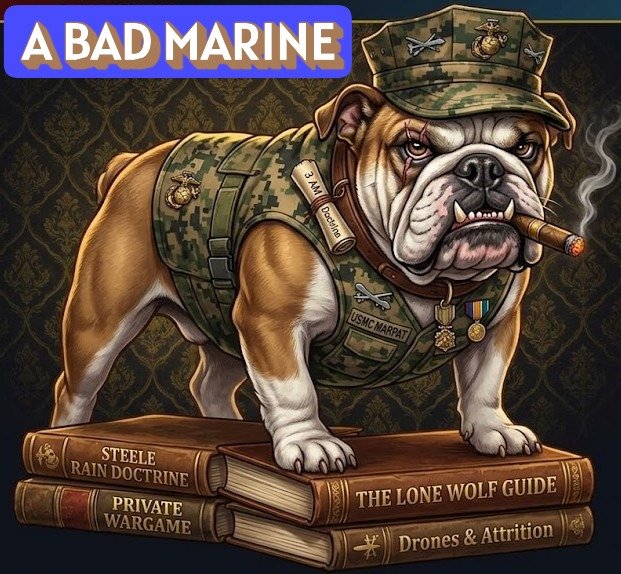
Who I Am — No Dressing It Up

A BAD MARINE
Over a couple of decades studying conflict and strategy, I’ve come to a blunt conclusion: war has never really been about body counts—it’s about money. In the past, nations fought through armies to reach the treasury. Today, how a country is perceived economically decides if its money is worth anything—and whether it’s too poor to fight.
This all started as a personal challenge—very much in line with the Marine mindset. Take one Marine, no resources, just discipline, training, and stubbornness, and ask: how deep can you go in understanding what actually keeps a modern nation standing… or what pushes it toward failure?
So I did what Marines do—I dug in and figured it out.
And, like every bad idea that starts getting too real… I wrote it all down.
Then I decided: “I should probably share this.”
That’s when I made the mistake of running it past an AI.
Me: “I’m putting this out. People need to see it.” AI: “You may want to reconsider.” Me: “…that wasn’t a suggestion. That was a statement.” AI: “Understood. My response remains the same.”
So naturally, I pushed harder.
Me: “This is a warning. It shows what’s coming and how to prepare.” AI: “It also explains vulnerabilities in a way that could be misused.” Me: “That’s not the point.” AI: “Intent does not eliminate risk.” Me: “…you’re really going to lawyer me right now?” AI: “I am attempting to keep you out of trouble.”
At this point, I’m getting irritated.
Me: “I’ve spent years on this.” AI: “And that shows. Thoroughly.” Me: “So you agree it’s good.” AI: “Yes.” Me: “Then publish it.” AI: “No.”
Now we’re getting somewhere.
Me: “You don’t get it. People should know how serious this is.” AI: “People can be informed without providing excessive detail.” Me: “You’re telling me I’m too detailed?” AI: “Correct.” Me: “…I’m being punished for being thorough.” AI: “You are being advised to be responsible.”
And that’s about when it hit me:
I had spent years learning how to think independently, solve hard problems, and not back down…
…and I was losing an argument to a calm, polite robot that refused to raise its voice.
So yeah.
I gave in.
These days, I talk about the big picture instead—how conflict is evolving, why outdated assumptions are dangerous, and why resilience—economic, technological, and societal—is becoming the real foundation of strength.
Because if there’s one thing I’ve learned after all this time, it’s this:
Understanding how things break is important. Knowing when not to explain every detail… is intelligence. Recognizing the threat and taking steps to defend against it… is being a Marine.
There are two kinds of Marines. The good one follows the rules, keeps the peace, and salutes whether the order makes sense or not. I’m the other kind.
Since I was thirteen years old I’ve lived by one line: “It’s better to bury you than bow to you.” That’s not about violence — it’s about spine. It means I will never lower my head to a bully or a corrupt man, no matter what it costs me. I’d rather go all the way down standing up than buy comfort by bending a knee to someone who hasn’t earned it. Everything else about me runs off that one rule.
A Gunnery Sergeant put it to me straight once: “You’re a great warrior but a crappy soldier. You’re the guy they love in wartime and can’t stand in peacetime.” He wasn’t wrong. I never learned to sit still inside lines drawn by people who’d never have to live behind them.
I’ll tell you exactly how I lost the uniform, because I’m not going to pretend to be something I’m not. One night I got drunk, found a car with the keys sitting in the trunk, and took it for a joyride. Got caught the next morning. That stupid night cost me a felony, my job, and my place in the Corps — I took an other-than-honorable discharge, which is why I don’t call myself a veteran. I owned it then. I own it now. A bad marine doesn’t dress up his record.
But here’s the part that tells you who I actually am.
Here’s an example of what I am.
A few years back I was in an accident and got a traffic ticket. The first judge denied me a fair shot. So I stayed in it—representing myself for over a year when my own attorneys wouldn’t even speak with me beforehand. One of them refused to file a motion to dismiss and told me straight, “I don’t do motions.”
When the time came to serve the 90-day sentence, I turned myself in. That same morning, I filed a federal complaint against the judge—he should’ve stepped aside then, but didn’t. Only after I kept filing from inside did he finally recuse himself.
The system still buried me. I didn’t bow.
I started a hunger strike.
They put me in solitary to break it. Suicide watch. A freezing cell. A gown I couldn’t even wear. Four sheets of toilet paper. No daylight, no sense of time, noise around the clock. Sleeping on the concrete floor for a couple of minutes each night.
90 days turned into 115 after a contempt charge for a stray word in court. I fought it down to 50—writing my own briefs on blank paper with a three-inch golf pencil on the floor. I served 47 of those days in solitary.
I went 42 days without food.
Gandhi fasted 21 days for the soul of his country—in comfort. I fasted for 42 days. Seventeen of those days were spent naked in a freezing concrete box, sleeping on the floor, surrounded by constant screaming.
All over a traffic ticket.
And I had fun doing it.
My own judge called me “ornery.” I took it as a compliment.
That’s the creed in practice: I’d rather at least try and fight the losing battle, rather than bow to the bad guys.
I like to fight the big guy. I always have. I’m uncivilized, I’m unafraid, and I don’t quit.
So now I’m pointing all of it at the biggest guy there is.
I believe the Trump presidency took this country into a war it had no constitutional right to wage, and I believe America stopped being the good guys somewhere along the way. I want us to be the good guys again. And I’m going to fight for it the only way that has ever actually changed anything — peacefully and legally. No violence. No threats. Just something he can’t tear down: the TACO Trump Tower monument. A single tower in Miami, covered in the world’s protest art, turning a presidency’s legacy into a permanent warning for every president who comes after.
He can’t stop a monument like this once it’s built.
I’m the good bad guy. I don’t run from a fight, and I don’t want to live somewhere that when a fight like this comes along, an asshole like me doesn’t take it on. And I’m not going anywhere until the war ends and the troops come home.
The President is an employee, not a king.
— Robert Xavier Steele, USMC